
 ✖
✖

The People's Emergency Briefing: Positives, serious flaws and corrections needed
The People's Emergency Briefing is a film that was launched on 7 April 2026.
The film starts well, making many good points about the seriousness of the climate emergency, but it is badly let down by its closing section which merely endorses the UK Net Zero 2050 Strategy, ignoring
(a) that the Strategy's target speed of cuts in CO2 emissions is far too slow
(b) that the Strategy does not even contain sufficient policies that will deliver the target cuts.
The project is also badly let down by the suggested action of calling for the UK Government to give a televised emergency briefing, ignoring
(a) the Government's record of persistent misinformation in claiming that its Net Zero 2050 Strategy is adequate
(b) the failure of a previous similar campaign (for a briefing of MPs) to make a significant impact.
The film promotes the dangerous misinformation that Net Zero 2050 is an adequate policy. The organisers of the film should correct the errors and then relaunch the film; the film should not be promoted until they have done so.
Rather than trusting the UK Government to give an accurate account in a national briefing, concerned citizens should advocate genuine emergency action and support the Tyndall Centre climate scientists who have rejected the Government's Net Zero 2050 strategy as grossly inadequate and carbon colonialism, and advocated a fundamental rethink of UK climate policy based on scientific rigour and international justice.
The People's Emergency Briefing project is sadly yet another example of climate campaigning falling far short of the high standards that are needed to deal with the climate emergency. Persistent campaigning failures are delaying effective action. There is a need for people to agree and adhere to a Code of Practice for policy making in order to improve standards.
The film starts well, making many good points about the seriousness of the climate emergency, but it is badly let down by its closing section which merely endorses the UK Net Zero 2050 Strategy, ignoring
(a) that the Strategy's target speed of cuts in CO2 emissions is far too slow
(b) that the Strategy does not even contain sufficient policies that will deliver the target cuts.
The project is also badly let down by the suggested action of calling for the UK Government to give a televised emergency briefing, ignoring
(a) the Government's record of persistent misinformation in claiming that its Net Zero 2050 Strategy is adequate
(b) the failure of a previous similar campaign (for a briefing of MPs) to make a significant impact.
The film promotes the dangerous misinformation that Net Zero 2050 is an adequate policy. The organisers of the film should correct the errors and then relaunch the film; the film should not be promoted until they have done so.
Rather than trusting the UK Government to give an accurate account in a national briefing, concerned citizens should advocate genuine emergency action and support the Tyndall Centre climate scientists who have rejected the Government's Net Zero 2050 strategy as grossly inadequate and carbon colonialism, and advocated a fundamental rethink of UK climate policy based on scientific rigour and international justice.
The People's Emergency Briefing project is sadly yet another example of climate campaigning falling far short of the high standards that are needed to deal with the climate emergency. Persistent campaigning failures are delaying effective action. There is a need for people to agree and adhere to a Code of Practice for policy making in order to improve standards.
The National Emergency Briefing - November 2025
The People's Emergency Briefing is a film that was launched on 7 April 2026.The organisers of the film had previously organised the National Emergency Briefing (NEB), an event held in Westminster Central Hall, London on 27 November 2025, where a set of climate and nature talks was given to an invited audience of over 1,200 including politicians. See Document 198: National Emergency Briefing: 'Positives, serious flaws and corrections needed'.
The organisers say the film will convey the key messages from the National Emergency Briefing.
Following on from the film, the organisers are calling for the UK government to give a national emergency TV briefing.
The NEB scientists explained the gravity of the climate emergency
Some of the key points in the NEB science presentations were as follows. Key points on the climate science
according to the National Emergency Briefing scientists
An emergency situation
Curent action is inadequate
Decision making
Radical change is needed
according to the National Emergency Briefing scientists
- The situation is now extremely serious and extremely urgent
- At current emissions, the planet will reach 1.5°C of global warming around 2030
- Total global emissions are still rising
- Nature is not a luxury - it is critical infrastructure
- The gulf stream is weakening - tipping points would be catastrophic
- The UK's food supply is at risk - crop growing could become impossible
- There is a risk of Government systems and institutions being overwhelmed
- Globally, billions of lives are at risk
- Climate action has been grossly inadequate
- The UK's Net Zero 2050 timescale of emission cuts is not what the UK promised in the Paris Agreement - it would take 3 times the UK's fair share of the 1.5°C carbon budget
- There is much misinfomation
- Decision makers must listen to the science
- Nothing can be changed until it is faced (quoting James Baldwin)
- "We have to be straight with people about the choices ahead"
- Current affluent, high-carbon lifestyles are unsustainable - and will end one way or another, either voluntarily or by a deteriorating climate with societal collapse
- Every fraction of a degree matters because the risks of catastrophic tipping points steadily increase.
- "We need transformational change now if we're going to survive"
See Document 198: National Emergency Briefing: 'Positives, serious flaws and corrections needed'.
The NEB scientists explained that emergency radical action is needed
The action needed to meet the UK's temperature and other commitments is as follows, according to the NEB scientists. UK policies that are aligned with climate science
according to the National Emergency Briefing scientists
according to the National Emergency Briefing scientists
- Transformational change starting immediately
- Fossil fuel use ended by 2030 - 2035
- Air travel cut by over 80% by 2030
- Manufacture of internal combustion engine cars ended immediately
- Most car journeys in urban areas replaced by public transport / walking / cycling
- Mass retrofitting of proper insulation for homes - and new homes to be zero carbon
- A diet with far less meat and dairy products
- A rapid shift to zero carbon electricity
- Adding up to profound changes in social norms and in the lifestyles of the well-off
- All justified by a recognition that current affluent, high-carbon lifestyles are unsustainable - and will end one way or another, either voluntarily or by a deteriorating climate with societal collapse.
This is very different to what is generally discussed, but, as Kevin Anderson pointed out in his NEB talk [1], it's only simple maths.
See Document 198: National Emergency Briefing: 'Positives, serious flaws and corrections needed'.
But two of the NEB speakers talked only about gradual transition
Two of the NEB speakers (speaking on economics [2] and energy [3]) ignored the science and talked only about gradual transition, adding to the general denial of the urgency of action.For example, while the NEB scientists explained that global warming will pass the 1.5°C target in about 2030 on current policies, and the need to end fossil fuel use by then or soon after, the economics speaker merely talked about 40% of new cars being EV's by then [2]. She seemed to be completely out of touch with the urgency of the situation.
What's wrong with Net Zero 2050
The UK Government's Net Zero 2050 Strategy is grossly inadequate for two reasons.The Strategy's target speed of cuts in CO2 emission is far too slow
The UK's Net Zero 2050 strategy is not in line with the science of carbon budgets and the Paris Agreement

NEB slide posted on Bluesky by Kevin Anderson
The UK Government and its Climate Change Committee justify the strategy via the use of false accounting - by (a) not counting all of the CO2 emissions that the UK is responsible for (ignoring aviation and emissions generated in the production of imported goods), and (b) not adhering to the Paris Agreement commitment to cut emissions faster than the global average in accord with the UK's above average emissions and the Paris principle of equity between nations [4][5].
The Strategy does not even contain sufficient policies that will deliver the target cuts
A net zero date of 2050 is decades away, far beyond the period of tenue of today's politicians and officials, enabling them to draft proposals that have little prospect of delivering what is promised such as carbon capture and storage, and sustainable aviation fuel. The Government's plans have twice been found to be unlawful (due to being inadequate) by the UK High Court [6].
The UK Government claims that it Net Zero 2050 Strategy meets the UK's obligations under the Paris Agreement to aim to keep global warming below 1.5°C. Considering that warming is currently at about 1.4°C and at current rates will reach 1.5°C in 2030, strategies to reduce emissions over 20 years clearly cannot be right. Instead, urgent radical transformation is needed.
Weak action advocated following the PEB film
Following on from the film, the main action advocated by the organisers is that the UK Government gives a national emergency TV briefing. This does not make sense given the following.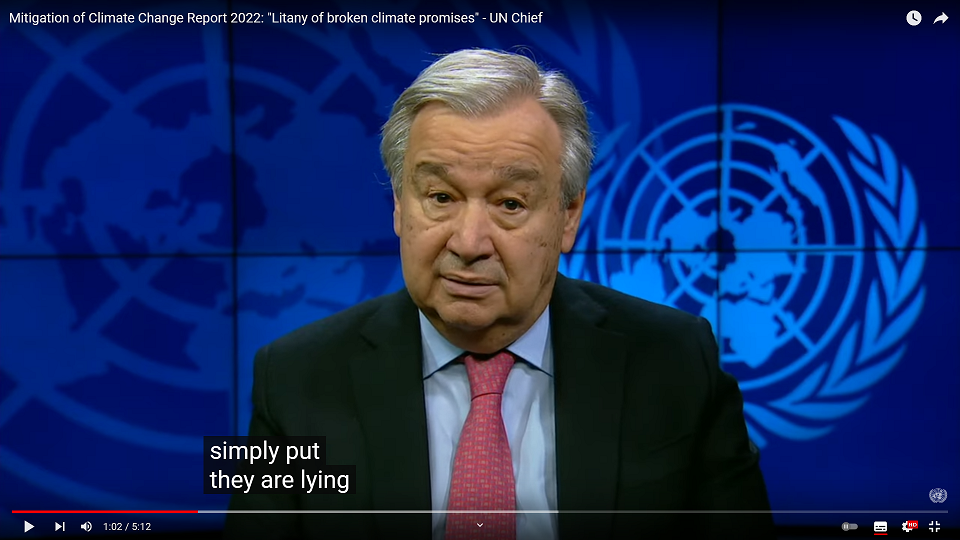
- A major impediment to effective climate action is the UK Government's policy of Net Zero 2050, which is far too slow (see above) - so expecting the Government to give a briefing in line with the science is unrealistic.
- The outcome of the previous similar initiative where Government scientists gave an online briefing to MPs was that they merely repeated the Government's Net Zero 2050 misinformation [7].
- Even the Secretary-General of the United Nations has warned that Governments cannot be trusted: "Some government leaders are saying one thing — but doing another. Simply put, they are lying." [8].
Conclusion: The People's Emergency Briefing project is seriously flawed
There are many positives in the project - there were some excellent talks from the NEB scientists setting out the dangers of the climate emergency.But there are also some serious flaws, and the project will make matters worse, if they are not corrected.
- Some messaging is not consistent with the science: The speakers at the National Emergency Briefing who gave talks on the science explained the need for urgent radical emission reductions, but the later economics and energy speakers ignored the science and talked only about gradual transition. See Document 198: National Emergency Briefing: 'Positives, serious flaws and corrections needed'. This glaring inconsistency has not yet been corrected, and is repeated in the People's Emergency Briefing film.
- Promotion of misinformation: This means that the urgency of the changes needed is not well conveyed.
- The weak action advocated
Corrections needed
- The NEB talks advocating gradual transition need to be replaced by information on urgent radical change.
- The PEB film promotes the dangerous misinformation that Net Zero 2050 is an adequate policy. The organisers of the film should correct the errors and then relaunch the film; the film should not be promoted until they have done so.
- Instead of calling for a national briefing by the Government, concerned citizens should advocate genuine emergency action, and support the Tyndall Centre climate scientists who have rejected the UK's Net Zero 2050 strategy as grossly inadequate and carbon colonialism, and advocated a fundamental rethink of UK climate policy based on scientific rigour and international justice [9].
The PEB project: a repeat of past errors of climate advocacy
When in 2018 the IPCC published its SR15 report [10], which clarified the importance of staying within the 1.5°C limit of global warming, advocates of climate action should have looked at what each country needed to do, in order to meet its commitments, and explain this action to decision makers and the wider public.In the UK, this meant radical changes including ending fossil fuel use by around 2030, ending leisure aviation, and replacement of most private car journeys by walking, cycling and public transport. But every section of society (including climate advocates) has avoided discussing such radical change, preferring to advocate much lesser (more popular) measures. This phenomenon is referred to by climate psychologists as implicatory climate denial [11], and has also been referred to as climate urgency denial, mitigation denial, and by Greta Thunberg as "blah-blah-blah".
The same failure has been repeated in other countries, with the consequence that global warming is now around 1.4°C, and it looks as if the 1.5°C target will be missed.
The PEB project is showing why radical action is so urgent, but when it comes to actions advocated, it is merely repeating past errors and advocating much watered down measures.
Many climate campaigners complain that populism is dominating politics and threatening to reverse climate action, but climate advocacy is also dominated by a similar populism. People are preferring to advocate measures that they think will be popular rather than explaining the hard choices that need to be made for a liveable future.
Code of Practice for policy making
The People's Emergency Briefing project is sadly yet another example of climate campaigning falling far short of the high standards that are needed to deal with the climate emergency. Persistent campaigning failures are delaying effective action. There is a need for people to agree and adhere to a Code of Practice for policy making [12].References
| [1] | Kevin Anderson (2025) National Emergency Briefing: Climate: Video and Transcript |
| [2] | Angela Francis (2025) National Emergency Briefing: Economics: Video and Transcript |
| [3] | Tessa Khan (2025) National Emergency Briefing: Energy Transition: Video and Transcript |
| [4] | UK Climate Change Committee: Not consistent with the IPCC https://www.carbonindependent.org/86.html |
| [5] | The UK Net Zero strategy would take three times the UK's share of the global carbon budget https://www.carbonindependent.org/109.html |
| [6] | Landmark High Court judgment finds government’s climate plan 'unlawful' – again (2024) https://friendsoftheearth.uk/latest/landmark-high-court-judgment-finds-governments-climate-plan-unlawful-again |
| [7] | Document 190: 'Climate science briefing for MPs by Patrick Vallence and others was seriously misleading' https://www.carbonindependent.org/190.html |
| [8] | Document 136: 'UN Secretary-General: "Government leaders are lying"' https://www.carbonindependent.org/136.html |
| [9] | Kevin Anderson, Chris Jones and Gaurav Gharde (2025) The UK’s year of climate U-turns exposes a deeper failure https://theconversation.com/the-uks-year-of-climate-u-turns-exposes-a-deeper-failure-254499 |
| [10] | Global warming of 1.5°C Special report (SR15 report): Summary for policymakers (2018) https://www.ipcc.ch/site/assets/uploads/sites/2/2018/07/SR15_SPM_version_stand_alone_LR.pdf |
| [11] | Document 147: Climate denial: literal, interpretive and implicatory https://www.carbonindependent.org/147.html |
| [12] | Document 196: Policy Making Code of Practice https://www.carbonindependent.org/196.html |
Started: 29 Mar 2026