
 ✖
✖

Mortality and other harms from climate change
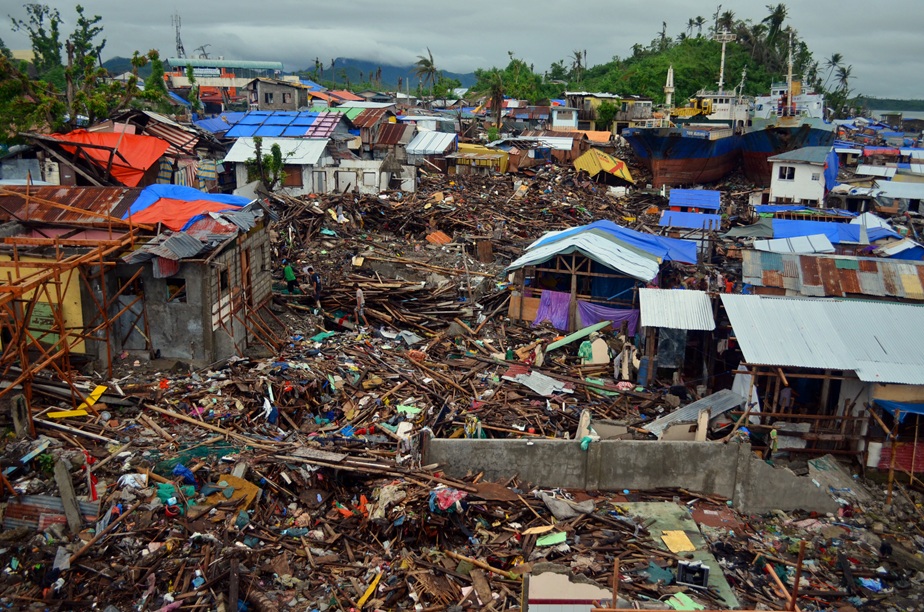
Damage from Typhoon Haiyan, the Philippines.
 Attribution: iStock
- mortality: around one climate death for each 4,000 tonnes CO2 emitted
- loss of habitable land and other causes of human displacement
- damage to the natural world
- rising sea levels
- steadily increasing risks of catastrophic tipping points.
The harm is unevenly distributed around the world.
While it is the richest countries that generate the most CO2 emissions per person, it is the poorest countries that suffer the worst effects.
Mortality from climate change
the Two studies have estimated how many climate related deaths will happen as a result of CO2 emitted. Both estimates were around one climate death for each 4,000 tonnes CO2 emitted.- A paper published in Nature [1] estimated one death per 4,434 tonnes CO2. The paper pointed out that this is equivalent to the lifetime emissions of 3.5 average Americans. This was reported in The Guardian [2].
- A second paper [3] gave an estimate of one death per 1,000 tonnes carbon burnt - which releases 3,700 tonnes CO2.
Climate-related deaths from the UK's CO2 emissions: 150,000 per year
The UK's total CO2 emissions, including imports and aviation, are currently about 9 tonnes CO2 per person per year [4] - giving a total for the 68 million UK population of about 600 million tonnes CO2 each year. This means that each year's CO2 emissions from the UK will result in around 150,000 climate deaths, using the figure of 1 death per 4,000 tonnes CO2 emitted.
UK aviation CO2 emissions are around 0.84 tonnes per person per year [5]. So the total mortality cost will be 14,000 climate related deaths for each year that UK aviation continues (equivalent to a weekly plane crash at a UK airport killing 270 people). This very high cost of aviation is generally ignored when aviation safety is being discussed in richer countries.
Other estimates
The Institute and Faculty of Actuaries has published estimates of global deaths at various temperature rises, though without giving a detailed rationale for the estimates [6]:
| Global warming | Global mortality |
|---|---|
| 1.5°C | 80 million |
| 2°C | 800 million |
| 3°C | 4 billion |
Loss of habitable land due to heat
Information comes from a study of unprecedented heat (mean annual temperature at least 29°C) [7]. Historically, very few people have lived in areas with mean temperatures as high as these. Some key conclusions are:- Global warming has already exposed about 9% of the world's population (over 600 million) to unprecedented heat.
- Current policies, leading to global warming of around 2.7°C, would leave about one third of the world's population exposed to unprecedented heat.
- One person will be exposed to unprecedented heat for roughly every 1700 tonnes CO2 emitted.
- Around 2.7 average EU citizens or around 1.2 average US citizens emit enough CO2 in their lifetimes to expose one future person to unprecedented heat, and the average citizen of Qatar emits enough CO2 in their lifetime to expose roughly 2.8 future people to unprecedented heat.
Damage to the natural world
As global warming worsens, the effects become more severe.For example, the SR15 report from the IPCC [8] explains that
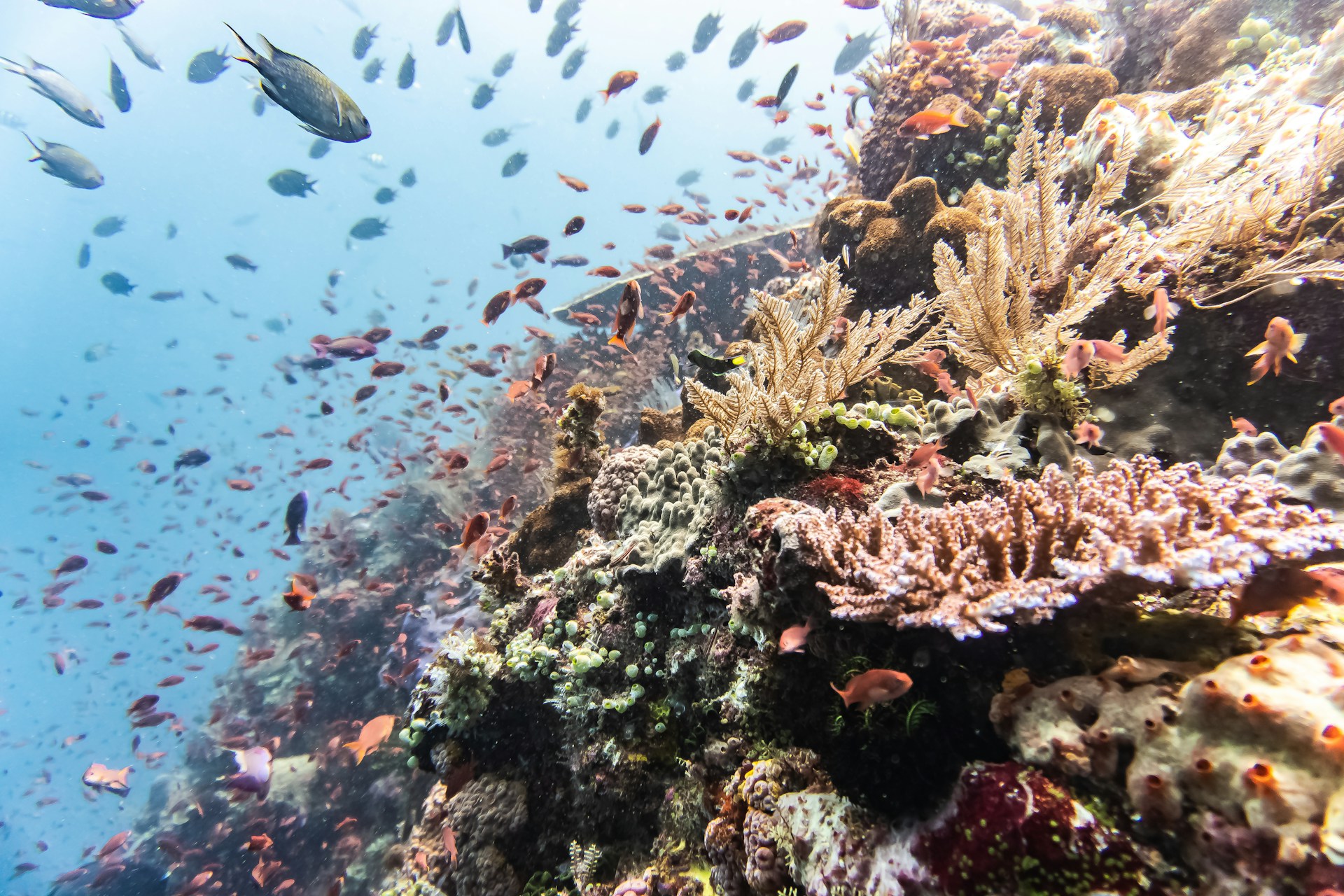
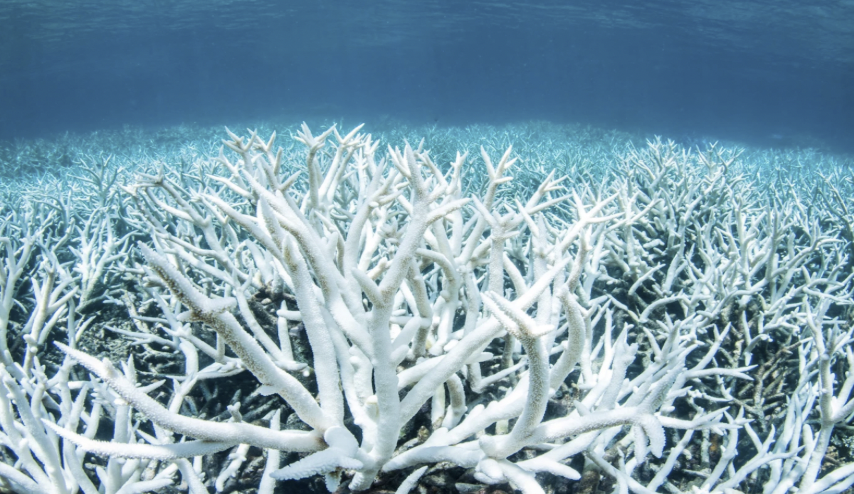
- the majority (70-90%) of warm water (tropical) coral reefs that exist today will disappear if global warming reaches 1.5°C (reference [8], p179)
- 99% of corals will be lost with warming of 2°C above the pre-industrial period (reference [8], p230).
Coral reef, Indonesia
 Attribution: Unsplash [9]
 Bleached coral reef
 Attribution: Wikimedia [10]
 Rising sea levels
Sea levels have risen as polar ice caps and glaciers have melted.Sea levels have already risen about 20cm compared to pre-industrial levels, and are currently rising about 5cm per decade [11]. As the earth warms up, sea levels rise more quickly.
This places a burden on those living in low lying coastal areas.
Even once the burning of fossil fuels has ended, sea levels will continue to rise, because the high temperatures will remain high, and ice will continue to melt.
The risks of catastrophic tipping points are steadily increasing
If global warming continues, and the climate continues to deteriorate, tipping points in the climate system will be passed and changes will become abrupt and/or irreversible [12][13].The effects on the planet including mankind will then accelerate.
The most important tipping points are
- melting of ice e.g. irreversible meltdown of the Greenland ice sheet
- disruption of ocean currents and atmopheric circulation e.g. collapse of the oceanic Atlantic Meridional Overturning Circulation (AMOC)
- biosphere tipping points including large-scale dieback of the Amazon rainforest.
References
| [1] | Bressler RD (2021) The mortality cost of carbon. Nature Communications (12) 4467 https://www.nature.com/articles/s41467-021-24487-w |
| [2] | Three Americans create enough carbon emissions to kill one person, study finds (2021) https://www.theguardian.com/environment/2021/jul/29/carbon-emissions-americans-social-cost |
| [3] | Parncutt R (2019) The Human Cost of Anthropogenic Global Warming: Semi-Quantitative Prediction and the 1,000-Tonne Rule Frontiers in Psychology (20) 2323 https://www.frontiersin.org/articles/10.3389/fpsyg.2019.02323/full |
| [4] | UK average greenhouse gas emissions https://www.carbonindependent.org/23.html |
| [5] | Our World in Data (2020) https://ourworldindata.org/carbon-footprint-flying |
| [6] | Planetary solvency - finding our balance with nature (2025) Institute and Faculty of Actuaries (Appendix 1) https://actuaries.org.uk/document-library/thought-leadership/thought-leadership-campaigns/climate-papers/planetary-solvency-finding-our-balance-with-nature/ (accessed 31 May 2025) |
| [7] | Lenton et al (2023) Quantifying the human cost of global warming Nature Sustainability https://www.nature.com/articles/s41893-023-01132-6 |
| [8] | IPCC SR15 report: Chapter 3: Impacts of 1.5°C of Global Warming on Natural and Human Systems (2019) https://www.ipcc.ch/site/assets/uploads/sites/2/2019/02/SR15_Chapter3_Low_Res.pdf |
| [9] | Unsplash https://unsplash.com/photos/a-large-group-of-fish-swimming-over-a-coral-reef-gMjSMGUr85s |
| [10] | Wikimedia https://commons.wikimedia.org/wiki/File:Bleached_coral_reef.png |
| [11] | Daniel Dickinson (United Nations) (2024) What is sea level rise and why does it matter to our future? https://news.un.org/en/story/2024/08/1153596 (accessed 14 Mar 2026) |
| [12] | Timothy M. Lenton (2021) Tipping points in the climate system https://rmets.onlinelibrary.wiley.com/doi/10.1002/wea.4058 (accessed 22 Jan 2026) |
| [13] | Bill McGuire (2023) The point of no return: how close is the world to irreversible climate change? Responsible Science journal, no.6 https://www.sgr.org.uk/resources/point-no-return-how-close-world-irreversible-climate-change (accessed 22 Jan 2026) |
First published: 15 Apr 2023