
 ✖
✖

Key climate information
For more details via infoboxes: hover, click or double-click on any highlighted text
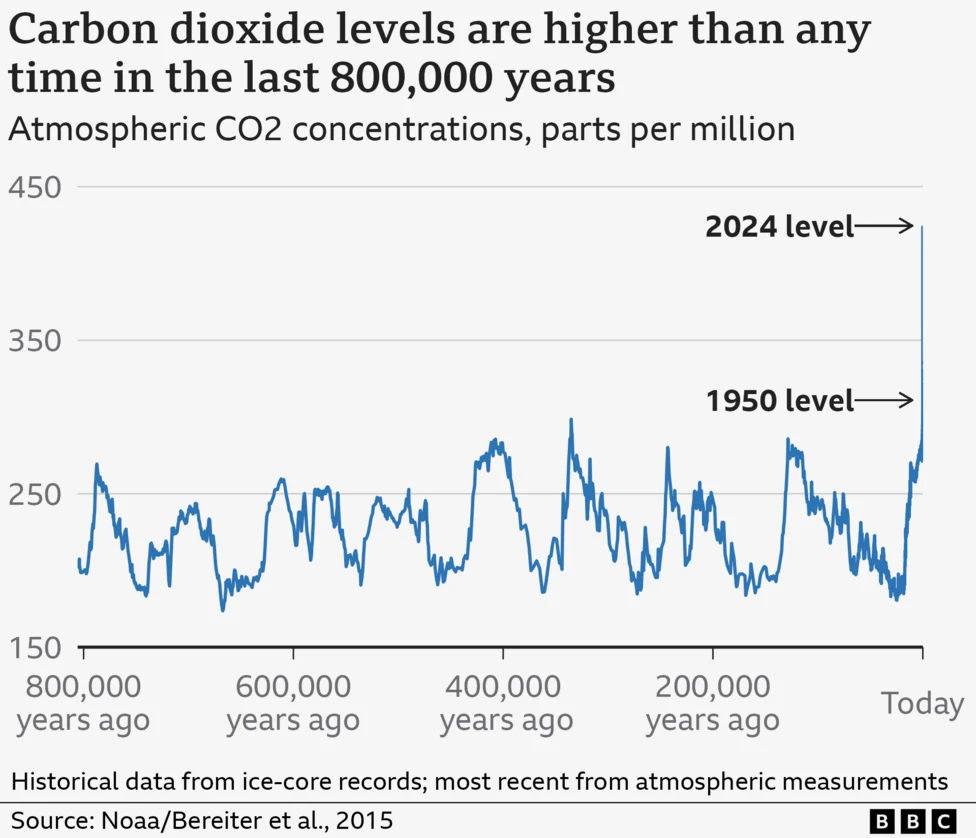
- Just over half of the CO2 added to the atmosphere by the burning of fossil fuels stays in the atmosphere.
- So, since the mid-1800's, the atmospheric concentration of CO2 has steadily increased.
- The CO2 in the atmosphere retains heat.
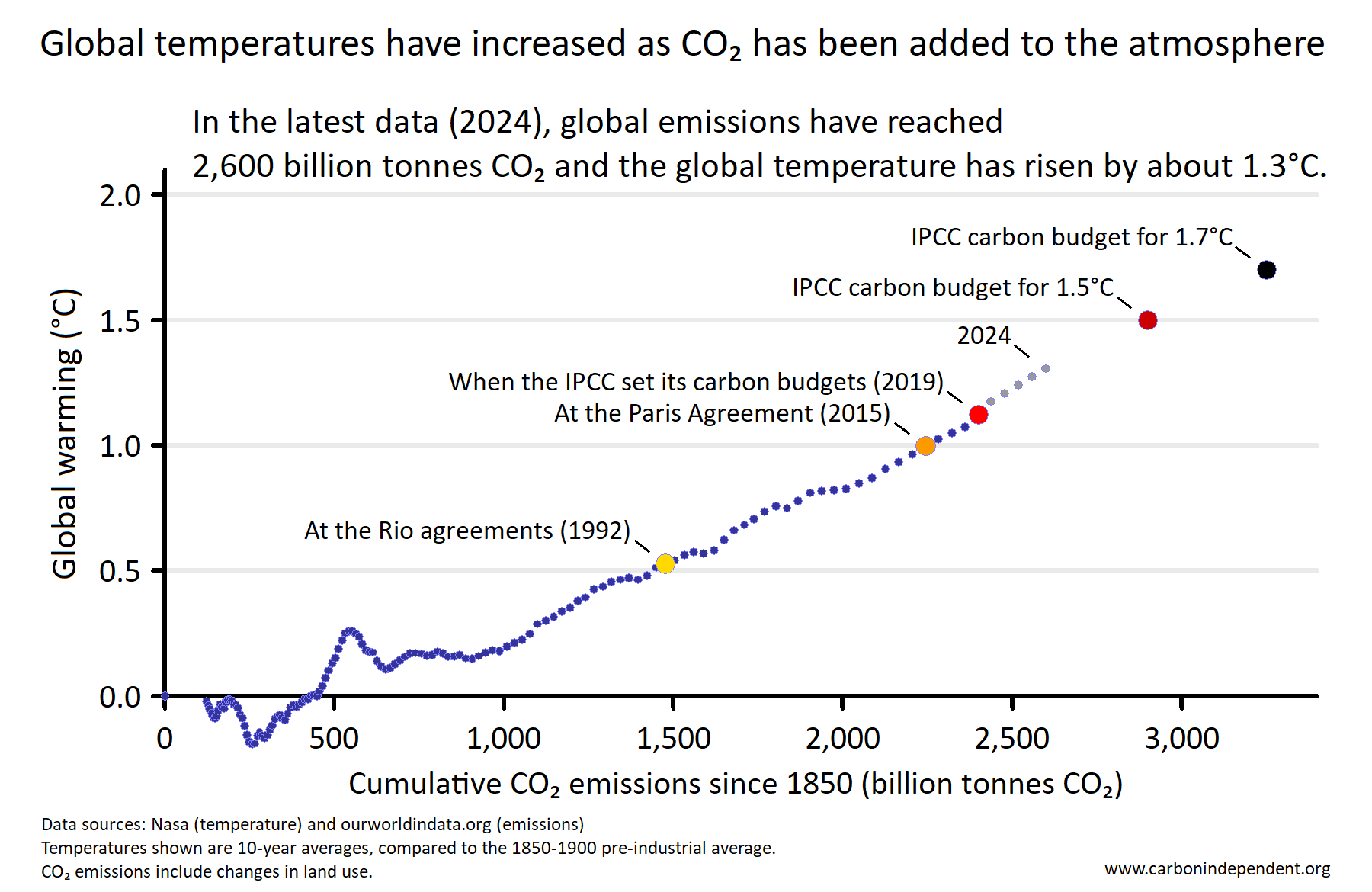
- So, as more and more CO2 has been added to the atmosphere, global temperatures have steadily increased.
- As well as the increased temperatures, there are more storms, floods, heatwaves and wildfires, sea levels are rising, and tipping points are nearing.
- These are causing unsustainable and unacceptable levels of climate deaths, climate refugees, and damage to nature.
- The urgency of climate action is given by the commitment in the Paris Agreement to make efforts to limit global warming to 1.5°C.
- The setting of a limit to global warming means that there is a limit to how much more CO2 can be added to the atmosphere (the carbon budget).
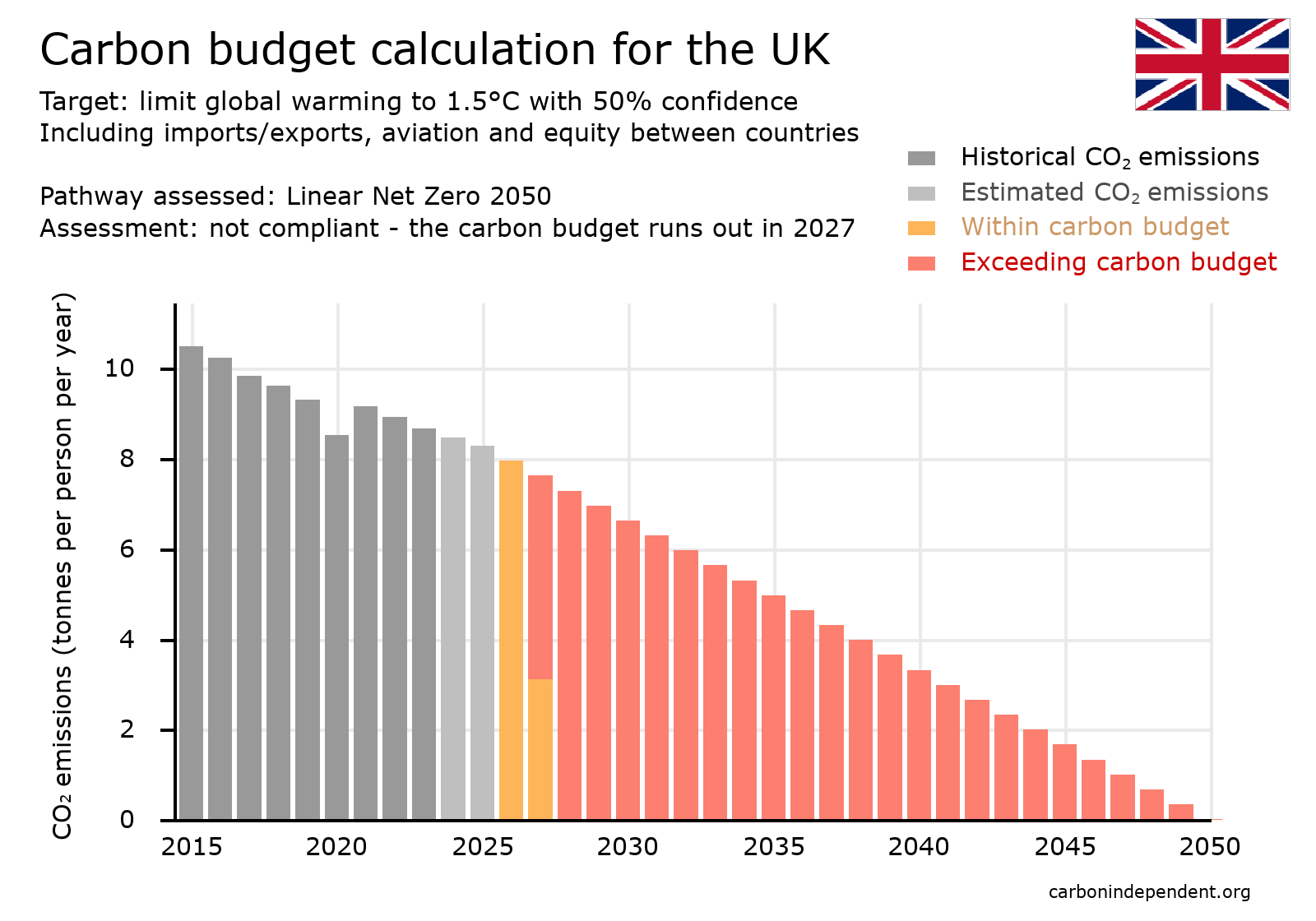
- The global carbon budgetfor 1.5°C runs out in about 2033, or earlier. The carbon budget runs out even sooner in developed countries, e.g. the UK's fair carbon budget for a 50% chance of limiting global warming to 1.5°C runs out in 2027.
- This means radical changes in lifestyles for many people until renewable alternatives are developed, if temperature targets are to be met.
There should have been agreement on a plan to rapidly eliminate fossil fuels in line with the climate science and the commitments given in the Paris and other agreements - and effective implementation of that plan.
There have been many declarations of a climate emergency, but planning has been of non-emergency policies, and there has been little action. The global total of CO2 emissions, which should have been falling rapidly, has continued to increase.
- There has been no general discussion of the extreme urgency from the dwindling carbon budget and the implications of radical change e.g. the closure of most airports within a few months.
- Instead, inadequate government timescales (such as Net Zero 2050) have dominated discussions and have been little challenged - with inadequate policies being advocated and planned.
- This seems to be not just misunderstandings but a form of climate denial, termed implicatory climate denial - exacerbated by wishful thinking, groupthink, overconfidence and other cognitive biases, and pseudoscience
- There has been a general failure across society: by government scientists, politicians, the media, climate campaigners, climate sceptics, businesses, other organisations, and individuals.
- current lifestyles are unsustainable, so radical change is coming one way or another - people can choose to organise radical change, or have disorganised radical change forced upon them by a deteriorating climate
- whether to continue with inadequate non-emergency policies or face up to the situation and treat climate change as the highest priority i.e. as an emergency
- whether to continue with the target of limiting global warming to 1.5°C or to accept that the system has failed and consider a higher limit of e.g. 1.6°C.
The science of climate change
Every tonne of CO2 emissions adds to global warming

- Just over half of the CO2 added to the atmosphere by the burning of fossil fuels stays in the atmosphere.
- So, since large scale burning of fossil fules started in the mid-1800's, the atmospheric concentration of CO2 has been steadily increasing.
- The CO2 in the atmosphere retains heat.
- So, as more and more CO2 has been added to the atmosphere, global temperatures have steadily increased (see chart).
- As well as the increased temperatures, there are more storms, floods, heatwaves and wildfires, sea levels are rising, and tipping points are nearing.
These changes are causing unsustainable and unacceptable levels of
- climate deaths: about one climate-related death per 4000 tonnes CO2 put in the atmosphere
- climate refugees
- biodiversity loss, e.g. destruction of coral reefs
Tipping points
If global warming continues, catastrophic tipping points in the climate system will be passed and changes will become abrupt and/or irreversible. The effects on the planet including mankind will then accelerate. The most important tipping points are- melting of ice:
- irreversible meltdown of the Greenland ice sheet
- irreversible retreat of the West Antarctic ice sheet, or of Wilkes Basin in East Antarctica
- ocean currents and atmospheric circulation:
- collapse of the oceanic Atlantic Meridional Overturning Circulation (AMOC)
- disruption of the West African monsoon, and of the South Asian/Indian summer monsoon
- biosphere tipping points including
- large-scale dieback of the Amazon rainforest and of boreal forests.
What should have happened after the Rio and Paris international agreements
By the late 1980's, it was clear that adding CO2 to the atmosphere does in fact cause global warming - it is not just a theoretical risk.At the
Rio 'Earth Summit'
of 1992, there were several important international agreements. These included the Rio Declaration. Its Second Principle
states that States have a responsibility to ensure that they do not cause damage to the environment of other States or other areas beyond their national jurisdiction.
A second agreement was the United Nations Framework Convention on Climate Change
(UNFCCC). Its
Article 2
states: "The ultimate objective of this Convention" is theand its
"stabilization of greenhouse gas concentrations in the atmosphere at a level that would prevent dangerous anthropogenic interference with the climate system".
Article 3
includes the agreed aim:to protect the climate for the benefit of present and future generations of humankind, on the basis of equity
The implications of these were that fossil fuel use would be phased out in a fair manner before rising levels of atmospheric CO2 became dangerous - but that is not what happened.
Instead, total annual global CO2 emissions increased rather than decreased.
Commitments in the Paris Agreement
By the time of the Paris conference of 2015, it was now clear that adding CO2 to the atmosphere not only increased global temperatures, but also increased the number and severity of extreme weather events, with large human costs - dangerous climate change had already been effected, in breach of Article 2 of the UKFCCC, in which countries made a commitment to prevent dangerous anthropogenic climate change (see above).The
most important commitments in the Paris Agreement
were:
- to limit global warming to well below 2°C (often taken to mean 1.7°C), and
- to pursue efforts to limit global warming to 1.5°C above pre-industrial levels
Two key scientific reports after the Paris Agreement
Following the Paris Agreement of 2015, countries should have implemented plans to reduce emissions. TheIPCC
produced two scientific reports which should have facilitated the process:Some key messages of the SR15 report [1] were
- "limiting global warming to 1.5°C would require rapid and far-reaching transitions"
- "These systems transitions ... imply deep emissions reductions in all sectors"
At the launch of the AR6 report, the IPCC explained the need for
"immediate, rapid and large-scale reductions in greenhouse gas emissions"The AR6 report [2] gave
carbon budgets for limiting global warming to 1.5°C and other values including 1.7°C
. The budget for 1.5°C was given as a further 500 billion tonnes CO2 from January 2020 (total global emissions of 2,900 billion tonnes CO2), and for 1.7°C as a further 350 billion tonnes CO2 (total global emissions of 3,250 billion tonnes CO2). The urgency has been further emphasized by the UN Secretary-General [3]:
"This is a climate emergency"
Following the Paris Agreement, there should have been a discussion of the implications of the Agreement, agreement of a plan to eliminate fossil fuels, and implementation of the plan.
- an assessment of the degree of urgency of action: leading to a decision of emergency (not routine) action
- a decision on the main objective: deciding on a limit to global warming of 1.5°C
- an understanding of the science of achieving this objective: staying within the appropriate carbon budget
- including the commitment in the Paris Agreement to equity between nations
- using a fair accounting system: including all CO2 emissions
- stating clearly the required speed of change: double digit percentage annual emission cuts
- detailing credibly compliant policies
- including effective quality control measures so that, for example, false solutions were avoided or challenged and eliminated.
See document 100: What should have been done by governments and wider society in response to climate change for details and sources.
What has actually been done
There have been many declarations of a climate emergency, but
- there has been no general discussion of the imminent exhaustion of the carbon budget - inadequate government timescales have dominated discussions and have been little challenged
- the rich countries have generally ignored their commitments to equity between countries and to cutting CO2 emissions faster than the global average
- there have been no competent plans - planning has been of non-emergency policies
- there has been little effective action.
The urgency of action on climate change in developed countries
to make efforts to limit global warming to 1.5°C
.The setting of a limit to global warming implies a limit to how much more CO2 can be added to the atmosphere (the
carbon budget
).The global carbon budget for 1.5°C runs out in about 2033, or earlier. The carbon budget runs out even sooner in developed countries, e.g. the UK's fair carbon budget for a 50% chance of limiting global warming to 1.5°C runs out in 2027 (see chart and document 195: UK carbon budget calculations 2026 ).
The implication of this is radical changes in lifestyles for many people until renewable alternatives are developed, if temperature targets are to be met.
The climate has changed particularly rapidly in the last few years suggesting that even more urgent change is needed.
What has gone wrong: a widespread failure of decision making
Information about the extreme urgency of action in developed countries should have been conveyed from the climate scientists to decision makers, i.e. to- decision makers in government
- decision makers in businesses and other organisations
- individuals.
The science is complex, and the changes needed are enormous, so this is not a straightforward process, but one that requires the effective involvement of many groups in society:
- scientists employed within government and scientists who contribute to government committees
- journalists and commentators
- advocates for climate action
- other campaigners in related fields, e.g. air quality and transport
- sceptics of climate action
- politicians
- businesses
- the legal system
- other organisations.
This process of translating the climate science into effective action has failed badly:
- There has been an almost universal failure to face up to the urgency of action: there has been no general discussion of the extreme urgency that comes from the imminent exhaustion of a fair carbon budget - 2027 in the UK for compliance with the 1.5°C commitment - and the implications of radical change e.g. the closure of most airports within a few months.
- Instead, the urgency of action has been understated - inadequate government timescales (such as Net Zero 2050) have dominated discussions and have been little challenged - with inadequate policies being advocated and planned.
- This seems to be not just a series of misunderstandings but a form of climate denial, termed implicatory climate denial - exacerbated by wishful thinking, groupthink, overconfidence and other cognitive biases, and pseudoscience.
- The evidence is that it is not a sporadic problem, and that it is not a conspiracy of oil companies or billionnaires (as sometimes stated) - instead there is a widespread failure of decision making - see document 189: Climate inaction and delay: Shambles or conspiracy?.
- This is a general failure across society: by government scientists, politicians, the media, climate advocacy groups, sceptics of climate action, businesses, the legal system, other organisations, and individuals.
- Even climate campaigners have contributed to the climate denial by understating the size and urgency of changes needed, with fragmentation of climate advocacy efforts - leading to chaotic, inconsistent and inadequate policy proposals.
It is crucial to understand what has gone wrong, so that mistakes are not repeated.
Why has decision making been so poor
Despite appearances, the squares marked A and B in the optical illusion are actually the same shade of grey.
See here.
 Attribution: Edward H. Adelson: Checker shadow illusion
 It seems that decisions are flawed because of
- ignorance
- cognitive biases including
- arrogance/overconfidence
- groupthink
- wishful thinking
- selective recall
- confirmation bias
- the bystander effect
- pluralistic ignorance
- self-interest
- lack of accountability.
What choices do people have now
- Whether to face up to the urgency of action, or to continue with the denial
- Current lifestyles are unsustainable, so radical change is coming - people can choose to organise radical change, or have disorganised radical change forced upon them by a deteriorating climate
- Whether to continue with inadequate non-emergency policies or face up to the situation and treat climate change as the highest priority i.e. as an emergency
- What target for climate action should be adopted
- The Paris Agreement commitment was to limit global warming to 1.5°C or at least well under 2.0°C. The target has been 1.5°C, but the fair UK carbon budget for 1.5°C runs out in 2027. There is a choice of whether to continue with the target of limiting global warming to 1.5°C or to accept that the system has failed and consider a higher limit of e.g. 1.6°C.
References
| [1] | IPCC (2018) SR15 report headline statements https://www.ipcc.ch/site/assets/uploads/sites/2/2019/06/SR15_Headline-statements.pdf |
| [2] | IPCC (2021) AR6 Climate Change 2021: The Physical Science Basis (Table SPM.2 on page 38) https://www.ipcc.ch/report/ar6/wg1/downloads/report/IPCC_AR6_WGI_SPM.pdf |
| [3] | Secretary-General of the United Nations (2021) https://www.un.org/sg/en/content/sg/statement/2021-08-09/secretary-generals-statement-the-ipcc-working-group-1-report-the-physical-science-basis-of-the-sixth-assessment |
First published: 13 Feb 2025