
 ✖
✖

UK campaigning failures
Action on climate change has not gone as intended, and so it is important to assess what has gone wrong. The evidence regarding climate campaigning is that it has been generally poor and could easily be much better.
The IPCC published its SR15 report in 2018. This clarified the importance of staying within the 1.5°C limit of global warming, and should have been followed by advocates of climate action helping to explain to decision makers and the wider public the climate science and the need for emergency action.
In the UK, appropriate action meant radical changes including ending the use of fossil fuels by around 2030, ending leisure aviation; replacement of most private car journeys by walking, cycling and public transport; a mass programme of home insulation; and a diet with much less meat and dairy.
 But little of this has happened. Instead, almost every section of society has avoided discussing such radical change, preferring to advocate much lesser (more popular) measures. This phenomenon is referred to by climate psychologists as implicatory climate denial, and has also been referred to as climate urgency denial, mitigation denial, or just "blah-blah-blah".
Amongst climate advocates, there has been
The end result is that campaigners have understated the urgency of climate action and advocated inadequate policies and have continued to do so even when alerted to the messaging and advocated policies being inadequate.
Many climate campaigners complain that populism is dominating politics and threatening to reverse climate action, but climate advocacy is also dominated by a similar populism. People are preferring to advocate measures that they think will be popular rather than explaining the hard choices that need to be made for a liveable future.
The famous quote from John Stuart Mill needs to be modified to
"All that is necessary for evil to triumph is for good people to look on and do the wrong thing".
Persistent campaigning failures have delayed effective action. Campaigning strategies need to be improved, and this should be helped by people agreeing and adhering to a Code of Practice for policy making.
The IPCC published its SR15 report in 2018. This clarified the importance of staying within the 1.5°C limit of global warming, and should have been followed by advocates of climate action helping to explain to decision makers and the wider public the climate science and the need for emergency action.
In the UK, appropriate action meant radical changes including ending the use of fossil fuels by around 2030, ending leisure aviation; replacement of most private car journeys by walking, cycling and public transport; a mass programme of home insulation; and a diet with much less meat and dairy.
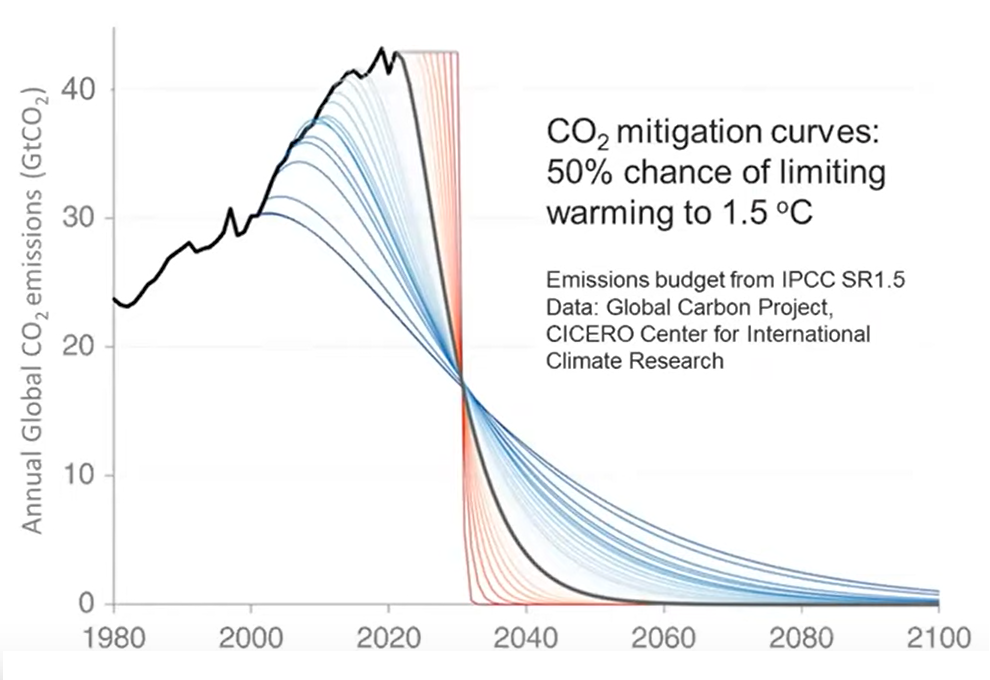
The CICERO chart illustrating that the later emission reduction is started, the faster it needs to be - and it has now become very urgent.
Amongst climate advocates, there has been
- fragmentation of efforts
- inconsistent messaging, with groups contradicting the IPCC and each other
- deliberate self-censoring
- repetition of fallacies
- not clearly explaining the errors in government decision making.
The end result is that campaigners have understated the urgency of climate action and advocated inadequate policies and have continued to do so even when alerted to the messaging and advocated policies being inadequate.
Many climate campaigners complain that populism is dominating politics and threatening to reverse climate action, but climate advocacy is also dominated by a similar populism. People are preferring to advocate measures that they think will be popular rather than explaining the hard choices that need to be made for a liveable future.
The famous quote from John Stuart Mill needs to be modified to
"All that is necessary for evil to triumph is for good people to look on and do the wrong thing".
Persistent campaigning failures have delayed effective action. Campaigning strategies need to be improved, and this should be helped by people agreeing and adhering to a Code of Practice for policy making.
Action on climate change has not gone as intended
It is important to assess what has gone wrong.The IPCC published its SR15 report [1] in 2018. This clarified the importance of staying within the 1.5°C limit of global warming. This should have been followed by advocates of climate action helping to explain to decision makers and the wider public
- the climate science
- why climate change requires emergency action
- what actions were needed to comply with international commitments and moral obligations
- what errors governments were making.
In the UK, appropriate action meant radical changes including
- ending the use of fossil fuels by around 2030
- ending leisure aviation
- replacement of most private car journeys by walking, cycling, or public transport, or by not taking them
- a mass programme of home insulation and lower temperatures
- changing to a diet with much less meat and dairy, and reorganisation of the food supply.
But little of this has happened - almost every section of society has avoided even discussing such radical change, even though is it only simple maths that those are the implications of the international agreements. Instead people have preferred to discuss much lesser (more popular) measures. This phenomenon is referred to by climate psychologists as implicatory climate denial [2], and has also been referred to as climate urgency denial, mitigation denial [3], and by Greta Thunberg as "blah-blah-blah" [4].
Amongst climate advocates, there has been
- fragmentation of efforts - there are many groups not coordinating their efforts
- inconsistent messaging, groups contradicting the IPCC and each other - leading to a cacophony of conflicting messages
- deliberate self-censoring [5]
- repetition of fallacies, e.g. advocating Net Zero dates and gradual decarbonisation
- not clearly explaining the errors in government decision making.
The end result is that that most UK climate campaigning groups have understated the gravity of the situation and advocated inadequate policies and have continued to do so even when alerted to the messaging and advocated policies being inadequate.
The same failure has been repeated in other countries, with the consequence that global warming is now around 1.4°C, and it looks as if the 1.5°C target will be missed.
Examples of climate denial in climate campaigners
Some UK examples are- Friends of the Earth (the UK's largest grassroots environmental organisation) has campaigned for the UK Government to keep to its Net Zero 2050 timescale of emission cuts despite knowing that the timescale is grossly inadequate, and that the Paris Agreement on 1.5°C requires UK fossil fuel use to be close to zero by 2030 - see Document 139 and Document 164 - Friends of the Earth have responded to criticism by saying that "if they told the truth, they would not be believed" [6].
- The two campaigning organisations Good Law Project and Client Earth are similarly spreading misinformation by supporting the High Court cases brought by Friends of the Earth - see Document 149.
- The UKHACC (the UK Health Alliance on Climate Change) is promoting a Net Zero 2040 timescale of emission cuts for the health service, even though they know this to be inconsistent with the UK's commitment to a 1.5°C limit to global warming - see the correspondence published in Document 175.
- Climate Emergency UK is assessing action by UK local authorities using an inadequate check list of actions - see Document 145.
- Extinction Rebellion was founded with a Demand of Net Zero 2025, but has recently watered down its aim to 50% cuts in emissions by 2030, claiming incorrectly that this is fair and effective climate action.
- the Zero Hour group (in promoting the Climate and Nature Bills) - see Document 174
- Desmog UK is endorsing the UK Government's Net Zero 2050 timescale of emission cuts.
Some arguments put forward for deliberately understating the gravity of the situation and the changes needed are:
- [telling the truth would mean] "the right-wing press would have a field day"
- [telling the truth] "would be an own goal"
- "action in line with the Paris Agreement would not be politically possible".
An example: Leisure aviation
A Twitter exchange on aviation campaigning
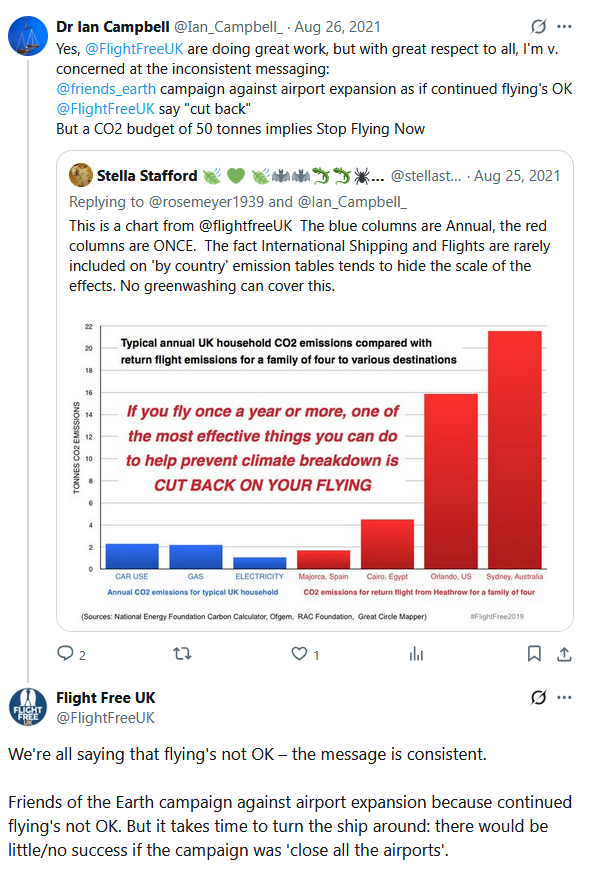
But climate campaigners have been very reluctant to say this - see the exchange on Twitter. So the crucial information about urgency of change has been suppressed, and leisure aviation has not just continued, but there are plans to increase it.
Conclusion
The end result is that campaigners have understated the urgency of climate action and advocated inadequate policies - and at the same time they have criticised the government and other organisations for doing just this. Campaigners have contributed to the climate denial that is widespread across society.Many climate campaigners complain that populism is dominating politics and threatening to reverse climate action, but climate advocacy is also dominated by a similar populism. People are preferring to advocate measures that they think will be popular rather than explaining the hard choices that need to be made for a liveable future.
There is a famous quote from John Stuart Mill [7] that can be paraphrased as
All that is necessary for evil to triumph is for good people to look on and do nothing.
Evil is clearly triumphing at present - global CO2 emissions are still rising. Looking at the global efforts to stop climate change, it seems that this quote should be modified to
All that is necessary for evil to triumph is for good people to look on and do the wrong thing.since an examination of the effort being made shows that much of it is unlikely to be effective, and may even be counterproductive.
Persistent campaigning failures have delayed effective action. Campaigning strategies need to be improved. It is not clear how best to combat climate denial in climate activists, but some possibilities are
- education
- the Science Oath of Scientists for Global Responsibility [8]
- a Code of Practice for policy making [9].
References
| [1] | Global warming of 1.5°C Special report (SR15 report): Summary for policymakers (2018) https://www.ipcc.ch/site/assets/uploads/sites/2/2018/07/SR15_SPM_version_stand_alone_LR.pdf |
| [2] | Document 147: Climate denial: literal, interpretive and implicatory https://www.carbonindependent.org/147.html |
| [3] | Kevin Anderson (2023) Getting real: what would serious climate action look like? https://www.sgr.org.uk/resources/getting-real-what-would-serious-climate-action-look |
| [4] | Document 119: Greta Thunberg's "blah blah blah" speech, Milan 2021 https://www.carbonindependent.org/119.html |
| [5] | Turning delusion into climate action - Prof Kevin Anderson, an interview (2020) Responsible Science https://www.sgr.org.uk/resources/turning-delusion-climate-action-prof-kevin-anderson-interview |
| [6] | Personal communication |
| [7] | John Stuart Mill (1867) St Andrew's University address https://www.openculture.com/2016/03/edmund-burkeon-in-action.html (viewed 11 Feb 2022) |
| [8] | https://www.sgr.org.uk/projects/science-oath-climate-text-and-signing |
| [9] | Document 196: Policy making Code of Practice https://www.carbonindependent.org/196.html |
First published: 4 Feb 2022