
 ✖
✖

What should have been done by governments and wider society in response to climate change
The problem of climate change from the burning of fossil fuels has been known about for decades. At the Rio Earth Summit of 1992, there was an agreement to prevent dangerous climate change, and the Paris Agreement of 2015 clarified what the limit to climate change should be (keeping the increase in global temperature to well under 2°C, pursuing effects to limit it to 1.5°C).
Following the Rio Agreements and then the Paris Agreement, there should have been a discussion of their implications, agreement of a plan to eliminate fossil fuels, and implementation of the plan.
A strategy should have been devised with the following key elements
All parts of society should have cooperated. In summary
Very little of this has happened.
- an assessment of the degree of urgency of action: leading to a decision of emergency (not routine) action
- a decision on the main objective: deciding on a limit to global warming of 1.5°C
- an understanding of the science of achieving this objective: staying within the appropriate carbon budget
- including the commitments in the Rio and Paris Agreements to equity between nations
- using a fair accounting system: including all CO2 emissions
- stating clearly the required speed of change: double digit percentage annual emission cuts
- detailing credibly compliant policies
- quality control measures should have worked, e.g. avoiding false solutions.
- climate scientists should have explained the key points of the scientific consensus
- government scientists should have echoed this explanation
- governments should have implemented effective policies
- the media should have conveyed the situation accurately to the general population
- businesses and other organisations should have implemented change
- quality control measures should have worked - so errors in decision making should have been corrected due to scrutiny by
- media
- commentators
- advocacy groups, campaigners and protesters
- the legal system
- individuals should have implemented change and ensured good decision making.
What should have happened after the Rio Agreements of 1992
By the time of the
Rio 'Earth Summit'
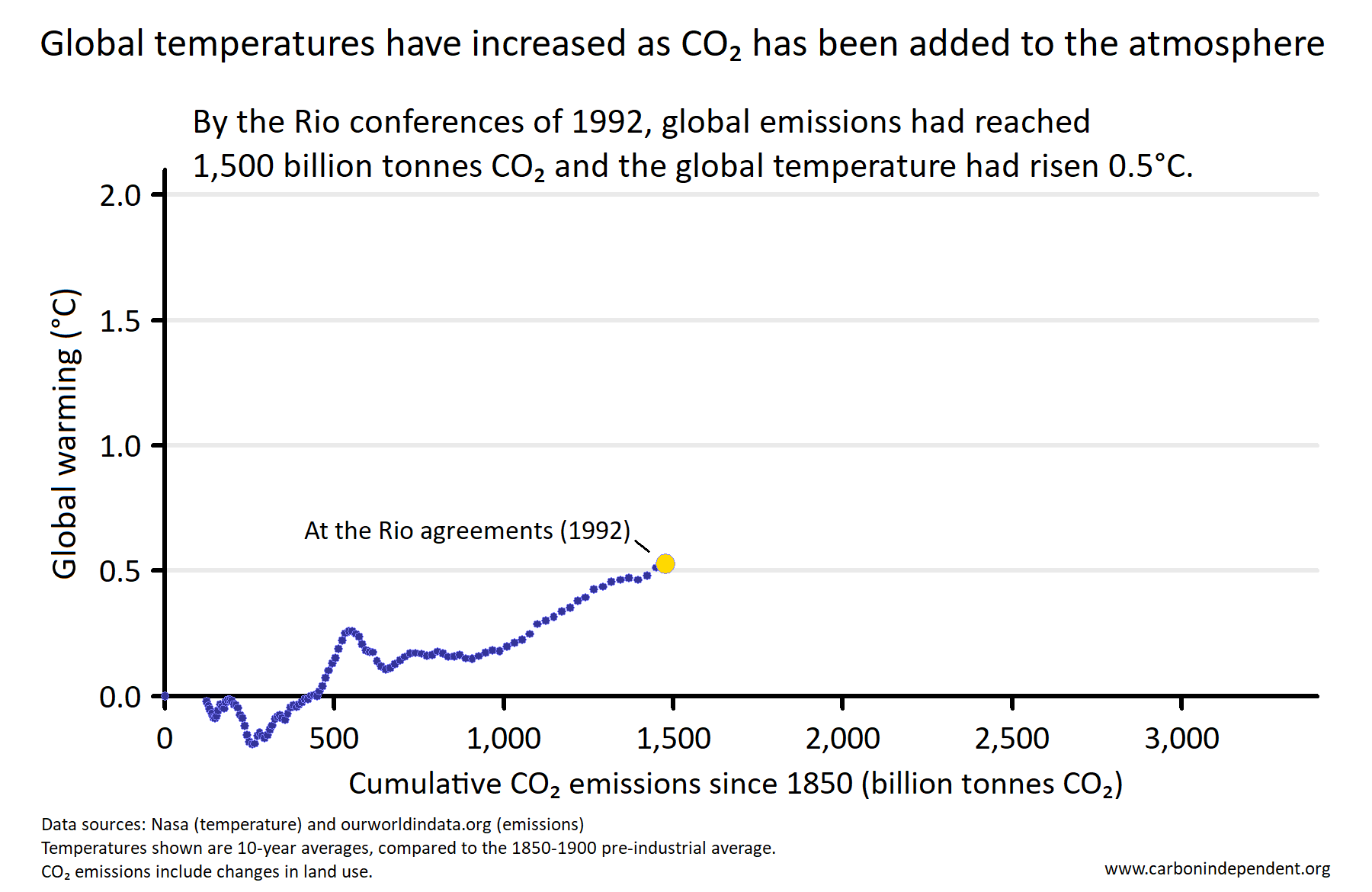
of 1992 [1], the cumulative total of global CO2 emissions had reached 1,500 billion tonnes CO2 and the global average temperature had risen 0.5°C (see chart).At the 1992 Summit, there were several important international agreements. These included the Rio Declaration [2]. Its
Second Principle
states that States have a responsibility to ensure that they do not cause damage to the environment of other States or other areas beyond their national jurisdiction.
A second agreement was the United Nations Framework Convention on Climate Change
(UNFCCC) [3]. Its
Article 2
states: "The ultimate objective of this Convention" is theand its
"stabilization of greenhouse gas concentrations in the atmosphere at a level that would prevent dangerous anthropogenic interference with the climate system".
Article 3
includes the agreed aim:to protect the climate for the benefit of present and future generations of humankind, on the basis of equity
The implications of these were that fossil fuel use would be phased out in a fair manner before rising levels of atmospheric CO2 became dangerous - but that is not what happened.
Instead, total annual global CO2 emissions increased rather than decreased.
Commitments in the Paris Agreement
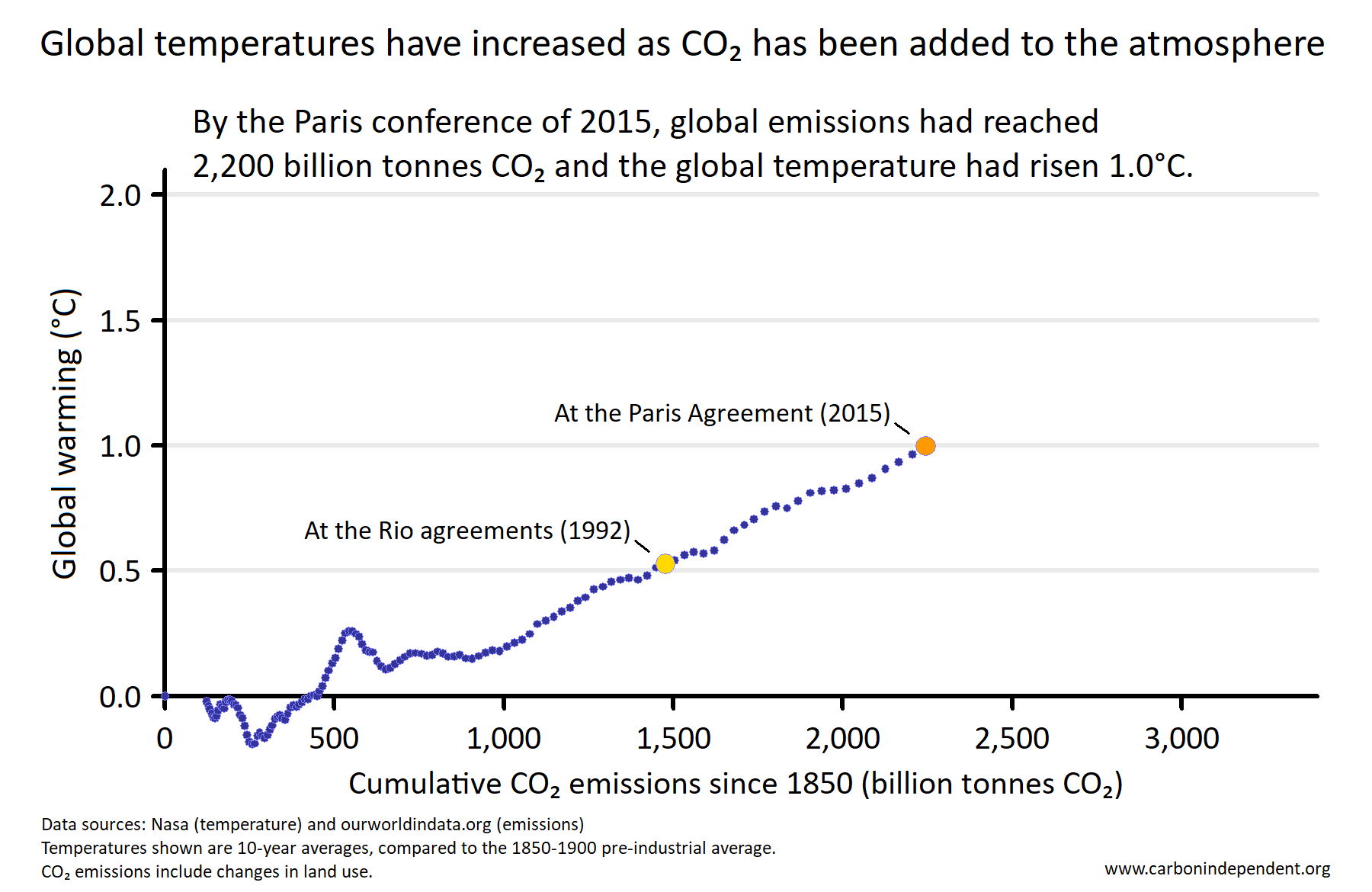
It was now clear that adding CO2 to the atmosphere not only increased global temperatures, but also increased the number and severity of extreme weather events, with large human costs - dangerous climate change had already been effected, in breach of Article 2 of the UKFCCC [3], in which countries made a commitment to prevent dangerous anthropogenic climate change (see above).
The
most important commitments in the Paris Agreement [4]
were:
- to limit global warming to well below 2°C (often taken to mean 1.7°C), and
- to pursue efforts to limit global warming to 1.5°C above pre-industrial levels
Two key scientific reports after the Paris Agreement
Following the Paris Agreement of 2015 [4], countries should have implemented plans to reduce emissions. The
1. The SR15 report of 2018
Some key messages of the SR15 report were
2. The AR6 report of 2021
At the launch of the AR6 report [7], the IPCC explained the need for
IPCC
produced two scientific reports which should have facilitated the process:Some key messages of the SR15 report were
- "limiting global warming to 1.5°C would require rapid and far-reaching transitions" [5]
- "These systems transitions ... imply deep emissions reductions in all sectors" [5]
- "Global emissions of CO2 would need to fall by about 45 percent from 2010 levels by 2030, reaching 'net zero' around 2050." [6], with greater falls in developed countries because of the commitments to equity in the Rio and Paris Agreements
At the launch of the AR6 report [7], the IPCC explained the need for
"immediate, rapid and large-scale reductions in greenhouse gas emissions"
The AR6 report gave
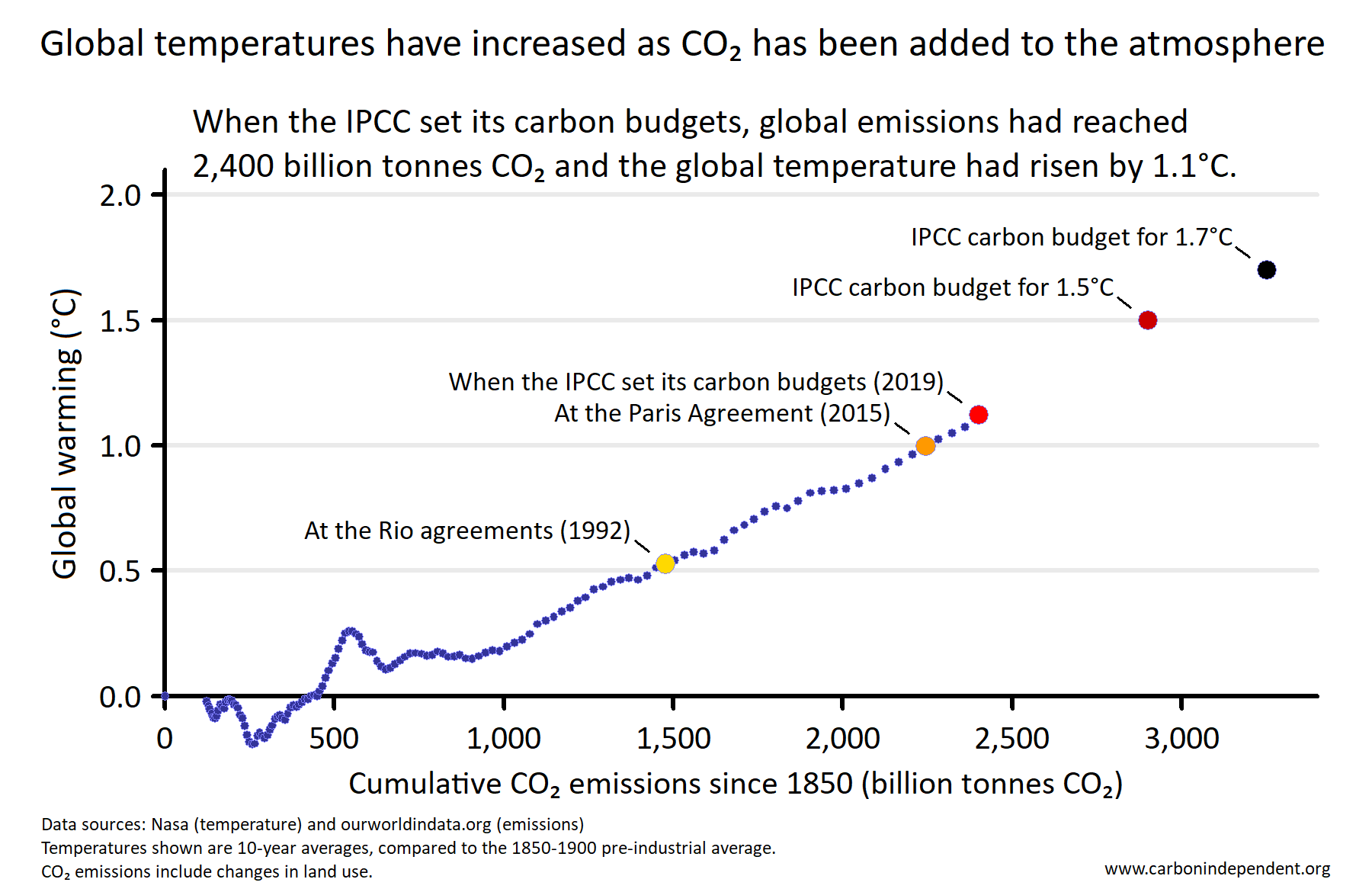
The urgency has been further emphasized by the UN Secretary-General [8]:carbon budgets for limiting global warming to 1.5°C and other values including 1.7°C
. The budget for 1.5°C was given as a further 500 billion tonnes CO2 from January 2020 (total global emissions of 2,900 billion tonnes CO2), and for 1.7°C as a further 350 billion tonnes CO2 (total global emissions of 3,250 billion tonnes CO2). "This is a climate emergency"
Key elements in a climate change strategy after the Paris Agreement
Following the Paris Agreement, there should have been a discussion of the implications of the Agreement, agreement of a plan to eliminate fossil fuels, and implementation of the plan.- an assessment of the degree of urgency of action: leading to a decision of emergency (not routine) action
- a decision on the main objective: deciding on a limit to global warming of 1.5°C
- an understanding of the science of achieving this objective: staying within the appropriate carbon budget
- including the commitments in the Rio and Paris Agreements to equity between nations
- using a fair accounting system: including all CO2 emissions
- stating clearly the required speed of change: double digit percentage annual emission cuts in affluent countries
- detailing credibly compliant policies
- including effective quality control measures so that e.g. false solutions are avoided or challenged and eliminated.
Decision making based on facts and fairness
Children develop a sense of fairness at an early age. Adults generally develop this inate sense of fairness into opinions and actions that aim to protect weaker members of society. To some extent, protecting weaker members of society is in everyone's personal interest since everyone can fall on misfortune. In democracies, those in positions of power are expected to behave according to specified standards, so that they do not abuse their power. These standards are set out in national codes of conduct and in international agreements such as the Universal Declaration of Human Rights [9]
All parts of society should have cooperated
- Climate scientists should have explained the key points of the scientific consensus:
- action is urgent and a very high priority because the harm is enormous, irreversible and cumulative
- the aim is to set a limit to global warming - to 1.5°C
- via limitation of the CO2 budget and equity in division between countries
- which means steady emission cuts to stay within this budget
- Government scientists and other parts of government should have echoed this explanation.
- Governments should have
- listened carefully
- recognised that climate change is an over-riding priority
- implemented effective policies
- The media should have conveyed the situation accurately to the general population.
- Businesses and other organisations should have implemented change.
- Quality control measures should have worked - so errors in decision making should have been corrected due to scrutiny by
- media - journalists should be willling to challenge anyone proposing a climate policy: how did they reach the policy decision from the evidence - why is their proposal different to other people's conclusions
- commentators
- advocacy groups, campaigners and protesters
- the legal system
- individuals should have implemented change and ensured good decision making.
The end result
The end result should have been a good response by all sections of society, so that- a limit to global warming was set
- a global CO2 budget was calculated
- the global CO2 budget was divided in a fair manner between countries
- in each country, a timescale of emission cuts was agreed so that emissions would stay within the CO2 budget for that country
- accounting procedures were carried out with integrity
- plans were made that would lead to the emission cuts agreed
- the plans were adhered to
- the problem was resolved.
Very little of this has happened
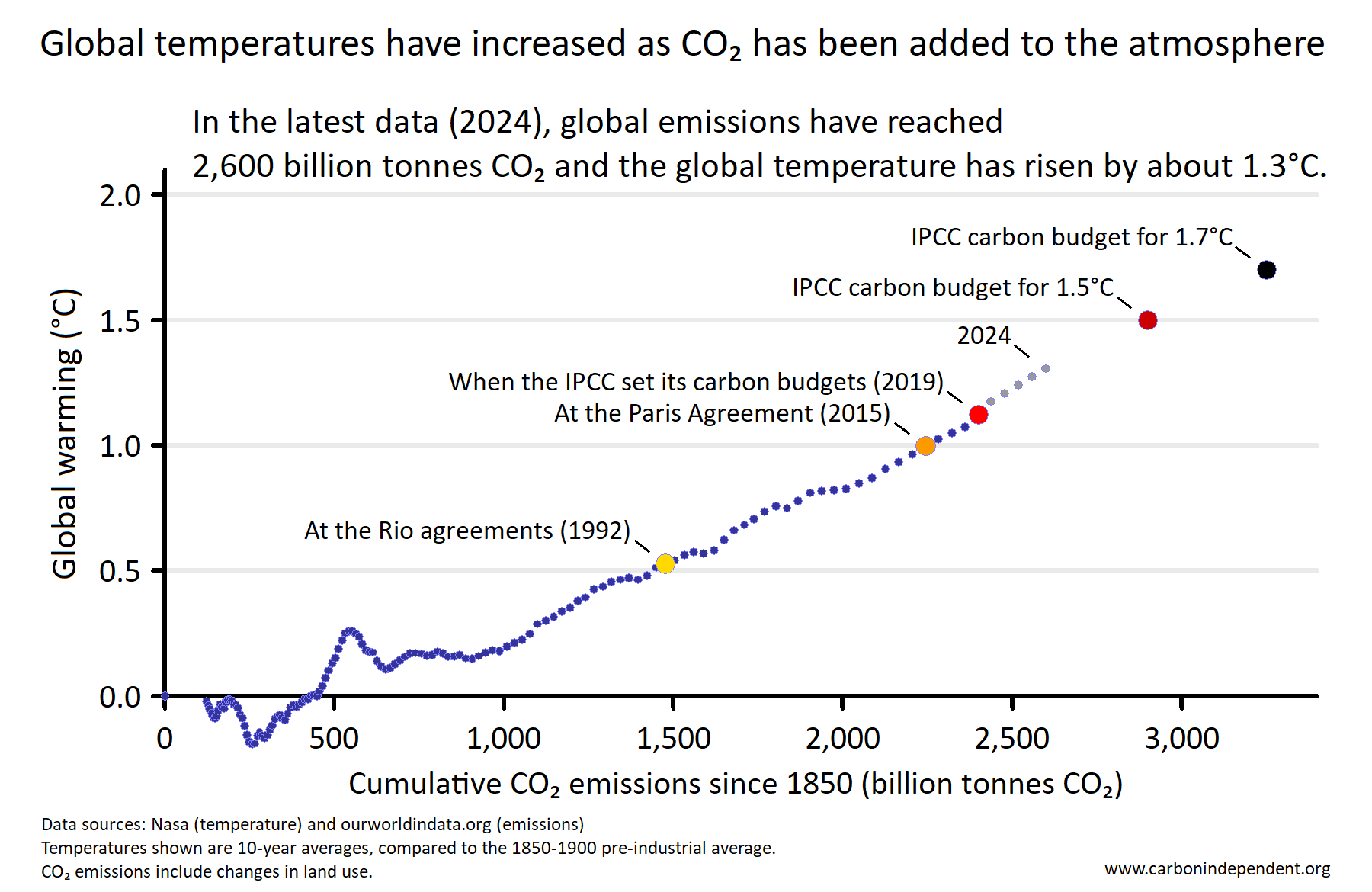
It's vitally important to consider why - and the evidence is that there is a general failure in policy making - see Document 189: Climate inaction and delay: Conspiracy or shambles?.
References
| [1] | Rio 'Earth Summit' - officially the United Nations Conference on Environment and Development (UNCED) (1992] https://www.un.org/en/conferences/environment/rio1992 |
| [2] | Rio Declaration (1992) https://www.un.org/en/development/desa/population/migration/generalassembly/docs/globalcompact/A_CONF.151_26_Vol.I_Declaration.pdf |
| [3] | United Nations Framework Convention on Climate Change (1992) https://unfccc.int/resource/docs/convkp/conveng.pdf |
| [4] | Paris Agreement (2015) https://unfccc.int/files/meetings/paris_nov_2015/application/pdf/paris_agreement_english_.pdf |
| [5] | IPCC (2018) SR15 report headline statements https://www.ipcc.ch/site/assets/uploads/sites/2/2019/06/SR15_Headline-statements.pdf |
| [7] | IPCC (2021) AR6 Climate Change 2021: The Physical Science Basis (Table SPM.2 on page 38) https://www.ipcc.ch/report/ar6/wg1/downloads/report/IPCC_AR6_WGI_SPM.pdf |
| [8] | Secretary-General of the United Nations (2021) https://www.un.org/sg/en/content/sg/statement/2021-08-09/secretary-generals-statement-the-ipcc-working-group-1-report-the-physical-science-basis-of-the-sixth-assessment |
| [9] | The Universal Declaration of Human Rights (1948) Proclamation by the General Assembly of the United Nations http://www.un.org/en/universal-declaration-human-rights/index.html |
| [6] | IPCC (Oct 2018) SR15 Summary for policymakers https://www.ipcc.ch/site/assets/uploads/sites/2/2018/07/SR15_SPM_version_stand_alone_LR.pdf |
First published: 20 Dec 2021